
Subscribe and receive email notifications of new blog posts.
 RSS Feed
- 2026 | 10 Posts
10
From Bidding Wars to Balance: What 10 Years of Home Prices Tell Us About the Lake Norman Market
If you bought or sold a home around Lake Norman during the last 10 years, you probably feel like you've lived through several completely different real estate markets. You're not imagining it. The numbers tell the story.
The national median home price reached $440,600 in July 2026, compared with approximately $245,000 in 2016. That's an enormous increase in just a decade. But what's happening nationally is only part of the story. Let's look at what those same years looked like right here in Huntersville, NC.
Huntersville home prices: 2016 vs. 2021 vs. 2026
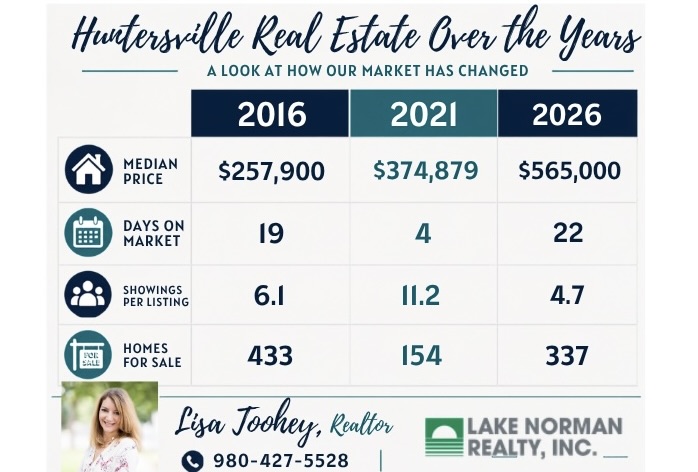
In July 2016, the median home price in Huntersville was $257,900. Five years later, in July 2021, the median had climbed to $374,879. And today? July 2026 brought a median home price of $565,000. That means the median Huntersville home has increased by more than $300,000 in 10 years. But price isn't the only thing that changed.
How quickly are homes selling?
In 2016, the average home spent about 19 days on the market. By July 2021, that number had dropped to an almost unbelievable 4 days.
Four. Days.
That was the COVID-era housing market in a nutshell. Buyers were competing for limited inventory, homes were selling almost immediately, and sellers often had multiple offers before they had time to put the "For Sale" sign in the yard.
Fast forward to July 2026, and we're at 22 days on market. At first glance, that might sound like the market has slowed dramatically. But compared with 2016's 19 days, it actually looks a lot more like a return to normal.
And then there's the number of showings
This is one of the more interesting statistics.
In 2016, listings averaged 6.1 showings.
In 2021, that number jumped to 11.2 showings.
In 2026, we're averaging just 4.7 showings per listing.
Why? Part of the answer may be that buyers have more choices.
Look at the number of homes available for sale:
2016: 433 homes 2021: 154 homes 2026: 337 homes
During the height of the COVID-era market, inventory was incredibly tight. Buyers didn't have many homes to choose from, and when a desirable property hit the market, buyers moved quickly. Today, there are more than twice as many homes available as there were in 2021. That gives buyers options. When buyers have options, they don't necessarily need to rush out and see every new listing that comes along.
So what does all of this mean?
To me, these numbers tell a pretty simple story:
We're moving back toward a more normal real estate market.
That doesn't mean prices are going back to 2016 levels. They aren't. And it doesn't mean we're going back to the days when homes sold in four days. Thankfully, buyers don't have to make life-changing decisions quite that quickly anymore.
What it does mean is that we need to adjust our expectations.
For sellers, a home may not go under contract the first weekend. A few showings without an offer doesn't necessarily mean something is wrong. Pricing, presentation, condition and marketing all matter, and buyers have more choices than they did a few years ago. For buyers, there is more breathing room. More inventory means more opportunities to compare homes, negotiate terms and make a thoughtful decision instead of feeling like you have to throw your best offer at a house within hours of seeing it.
And perhaps most importantly, we need to stop using the COVID-era market as our measuring stick. That market was an anomaly. It was fueled by historically low interest rates, extremely limited inventory, pandemic-related lifestyle changes and a huge surge in demand. It was real, but it wasn't necessarily "normal." Today's market is different.
Homes are still worth significantly more than they were 10 years ago. Buyers are still paying substantially more. And interest rates are certainly not what they were in 2021. But the relationship between buyers, sellers, inventory, showings and days on market is beginning to look a lot more familiar. And honestly? Normal might be a pretty good thing. Because real estate doesn't have to be a frenzy to be a healthy market.
Sometimes, 22 days on market instead of 4 isn't a problem.
Sometimes, 4.7 showings instead of 11.2 isn't a problem.
Sometimes, having 337 homes to choose from instead of 154 is exactly what buyers need.
The market has changed. The key isn't wishing it would go back to 2021. It's understanding the market we're in now and adjusting our expectations accordingly.
The COVID-era real estate market was extraordinary. The market we're in now is returning to a more "normal" scenario. Knowing the difference can make you a much smarter buyer or seller.
About the author: Lisa Toohey is a Realtor with Lake Norman Realty, helping buyers, sellers, and relocating families navigate the Lake Norman and greater Charlotte real estate market. With more than 24 years as a successful business owner before entering real estate, Lisa brings creativity, strategic thinking, and exceptional customer service to every client relationship. Through her affiliation with Leading Real Estate Companies of the World, she also helps clients relocate virtually anywhere in the world. Her mission is simple: provide honest advice, local expertise, and a real estate experience that's as personal as it is professional.
Turn the Key with Lisa T!

|
 |
